
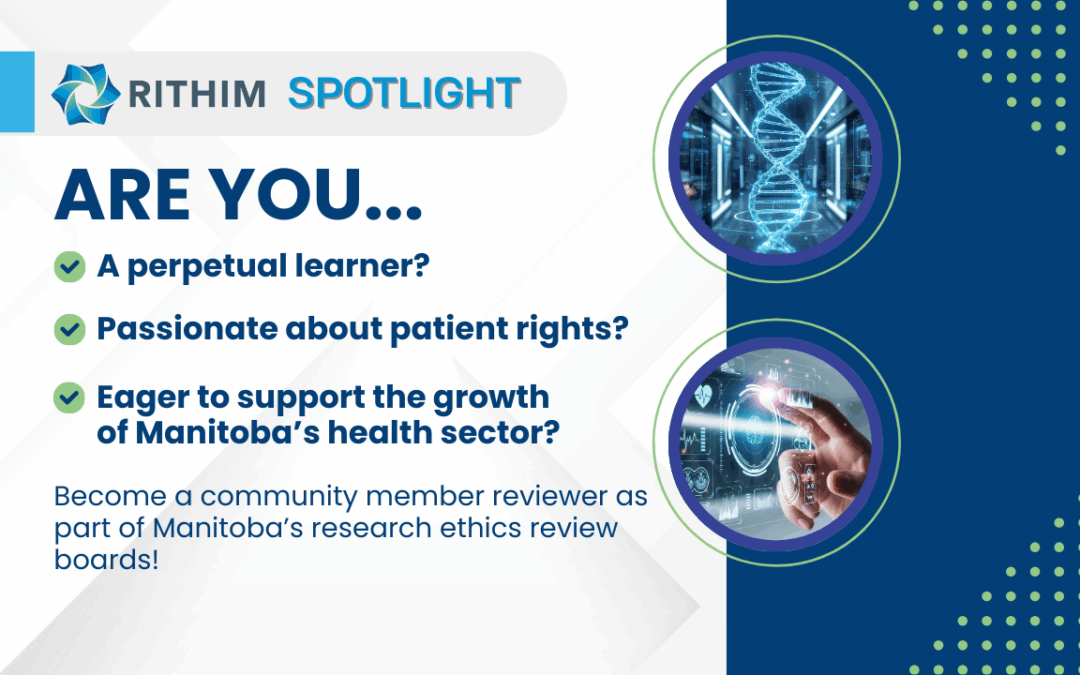
Protecting Participants: An Intro to Community Members on Research Ethics Boards
by Hope Holmes, Communications Officer, Research Manitoba – Jan 2026
This is a repost of our recent Winnipeg Free Press article: “Protecting Participants: Why your voice belongs on research ethics boards“.
Imagine living with a health condition and being invited to take part in a research study that could change the future of treatment for you and countless others.
Would you fully understand what you are agreeing to? Would the risks be clearly explained? Would you feel pressured to participate, or confident in your rights? These questions sit at the heart of research ethics, and they are exactly why community members play a critical role on research ethics boards.

Across Manitoba, hundreds of research studies each year are reviewed for ethical and privacy concerns, before research can begin. These reviews are not carried out only by scientists or health system professionals. They also rely on everyday Manitobans who bring lived experience, and public accountability into the process. For many health research projects, these reviews are carried out by committee members of the Manitoba provincial research ethics board called CHIPER (Committee for Harmonized Health Impact, Privacy and Ethics Reviews).
Community members ensure that research is examined not only through technical and scientific standards, but also through the lens of the patients, participants, and impacted communities. Their presence helps safeguard dignity, privacy and informed consent, strengthening public trust in the research system.
“As a person who had the privilege to be on the research ethics board is the following: it is very important, and I would almost say critical. To have a wholesome well-rounded study, the voice and perspective of the public is needed. Research has its structured format but the view from a person who will be participating or engaging with the research is important. Researchers could speculate about how the process, format and questions will be engaged with, but a “lay person” involvement prior helps to provide a humanistic interpretation.”
The need for independent community oversight is rooted in history. In Canada and around the world, historical research practices have caused harm by failing to protect participants’ safety, autonomy and rights. These lessons shaped today’s ethics review system, which helps identify potential harm before it occurs. Community representation is now considered essential to ethical oversight, ensuring decisions reflect public values.
Although every ethics board member carefully considers participant’s safety and welfare in their reviews, community members provide a focused, independent voice dedicated solely to protecting the interests of research participants.
Community members often help to identify practical questions, such as:
- Is the consent form written in plain language?
- Are risks explained clearly?
- Does the recruitment process place pressure on vulnerable populations?
- Could participation feel confusing or intimidating?
One of the most common contributions community members make is improving participant-facing materials, asking for changes to consent forms, information sheets and recruitment advertisements if they are overly technical, unclear or difficult to understand. Community reviewers help ensure people can make informed decisions without feeling rushed or misled.
You do not need formal research training to become a community member! Strong communication, empathy, attention to detail and lived experience navigating the health system are essential skills for the role. Many community members have participated in clinical trials, supported family members through medical care, or worked in advocacy and service roles. These perspectives strengthen ethical review by grounding decisions in lived reality.
Serving on a research ethics board such as CHIPER is also personally rewarding. Members gain insight into how health research works, contribute to the public good and help protect future participants. Training and mentorship are provided, and many community members report that the experience builds confidence and transferable skills that benefit their professional and personal lives.
“Being a community representative for 20 years, I have found the experience educational and very rewarding. I enjoy reviewing the new research protocols and learn something new each time. It is gratifying when you realize that a ‘protocol’ that has been approved by our Board, could potentially change someone’s life!”
Despite the importance of these roles, many ethics boards struggle to recruit community representatives. A 2023 national surveyin the United States found that nearly half of research ethics boards reported difficulty recruiting community members. This challenge is often linked to limited public awareness and concerns about time commitment.
In Manitoba, CHIPER meets only once per month and assignments are manageable. Many community members balance this role alongside other full-time responsibilities. In addition, all meetings are held virtually, allowing participants from across the province to contribute, and reviews are fully conducted through an online software system.
Another challenge is ensuring diversity among community representatives. Ethics boards benefit when voices reflect Manitoba’s varied communities, cultures and experiences. People from rural areas, newcomers, Indigenous communities, caregivers and former research participants all bring perspectives that strengthen ethical decision-making.
Manitoba-based potential community reviewers are invited to apply to serve on CHIPER, which has both biomedical and health-focused reviews for institutions across Manitoba. By participating, community members help ensure that human research conducted in the province remains ethical, transparent and participant-centred.
The voice of a community member is not symbolic. It carries real influence in shaping safer study designs, clearer communication and stronger participant protections. By serving on a research ethics board, Manitobans can help neighbours, family members and future patients who rely on ethical research to improve health care.
For more information about becoming a community member reviewer, contact info@researchmb.ca.
For more information on CHIPER’s current membership, please visit: CHIPER Membership Requirements.
Additional reading:
- Mosby, Ian. “Administering Colonial Science: Nutrition Research and Human Biomedical Experimentation in Aboriginal Communities and Residential Schools, 1942-1952.” Histoire sociale/Social History (2013). https://hssh.journals.yorku.ca/index.php/hssh/article/view/40239
- MacDonald, Noni E. “Canada’s shameful history of nutrition research on residential school children.” Paediatrics & Child Health (2014) (academic commentary; open access). https://pmc.ncbi.nlm.nih.gov/articles/PMC3941673/
- Interagency Advisory Panel on Research Ethics. Tri-Council Policy Statement: Ethical Conduct for Research Involving Humans (TCPS 2, 2022) – Chapter 9: Research Involving the First Nations, Inuit and Métis Peoples of Canada. https://ethics.gc.ca/eng/tcps2-eptc2_2022_chapter9-chapitre9.html
- Canadian Institutes of Health Research (CIHR). “Ethics of Health Research Involving First Nations, Inuit and Métis Peoples.” https://cihr-irsc.gc.ca/e/29339.html
- Gremillion, Helen; Tolich, Martin; Bathurst, Ralph. “Lay members of New Zealand research ethics committees: Who and what do they represent?” Research Ethics (2015). https://journals.sagepub.com/doi/abs/10.1177/1747016115581723
- Nicholls, S G, et al. “A cross sectional survey of recruitment practices, supports, and perceived roles for unaffiliated and non-scientist members of IRBs.” AJOB Empirical Bioethics (2023) (open access). https://pmc.ncbi.nlm.nih.gov/articles/PMC10444906/
- Green, Frank A. “Further thoughts on the recruitment of REC lay members.” Research Ethics Review (2007) https://journals.sagepub.com/doi/pdf/10.1177/174701610700300104
- Schmaltz, Rodney M., and Paddi O’Hara. “Results of a Literature Search on the Role of the Lay Representative in Research.” Report for the Canadian Cancer Clinical Trials Network (2013) https://3ctn.ca/wp-content/uploads/2022/04/FINAL-Report-Lay-Reps-November-08-2013_0.pdf
- Bates, Peter. “How to make the case that Public Contributors are Citizen Ethicists.” https://peterbates.org.uk/wp-content/uploads/2020/12/How-to-make-the-case-that-Public-Contributors-are-Citizen-Ethicists.pdf
- Rappaz, Sampoorna. “Meet and Share session on protecting the public from undue harm during research studies: A report.” Medical Writing (EMWA) 32(4) (December 2023) https://journal.emwa.org/biotechnology/medical-communications-and-writing-for-patients/article/15314/medical-communicationsand-writing-for-patients.pdf